Uncle George (1920–1940)
Poetry
Longed to be a soldier, like the Dad he adored. Had a twin sister, Mary, who defended him against bullies. Prayed, at 16, to get into military school, and did—though Mary couldn’t go and couldn’t keep him from being sent home for wetting the bed.1 Worked for an accountant, then a solicitor. Every Thursday, brought home flowers for his Mum. Enlisted at 17. Volunteered for France at 192—leaving with another young soldier a photo of himself, dark-eyed, pale, beautiful in his dress uniform. Arrived with his company in Rennes, June 17, 1940, just before Hitler’s planes flew over the train station and released their bombs. Had his photo, the one he gave Milton White, appear six weeks later on the front page of The Colchester Gazette, accompanied by a plea from Milton’s parents: their missing son had among his things this photo, with George written on the back.3 Could this George help them find their boy? But George, also missing, could help no one. In the seconds after he heard the planes, had he longed for Mary’s arm around him? Did he have time to reach for Milton’s hand?4
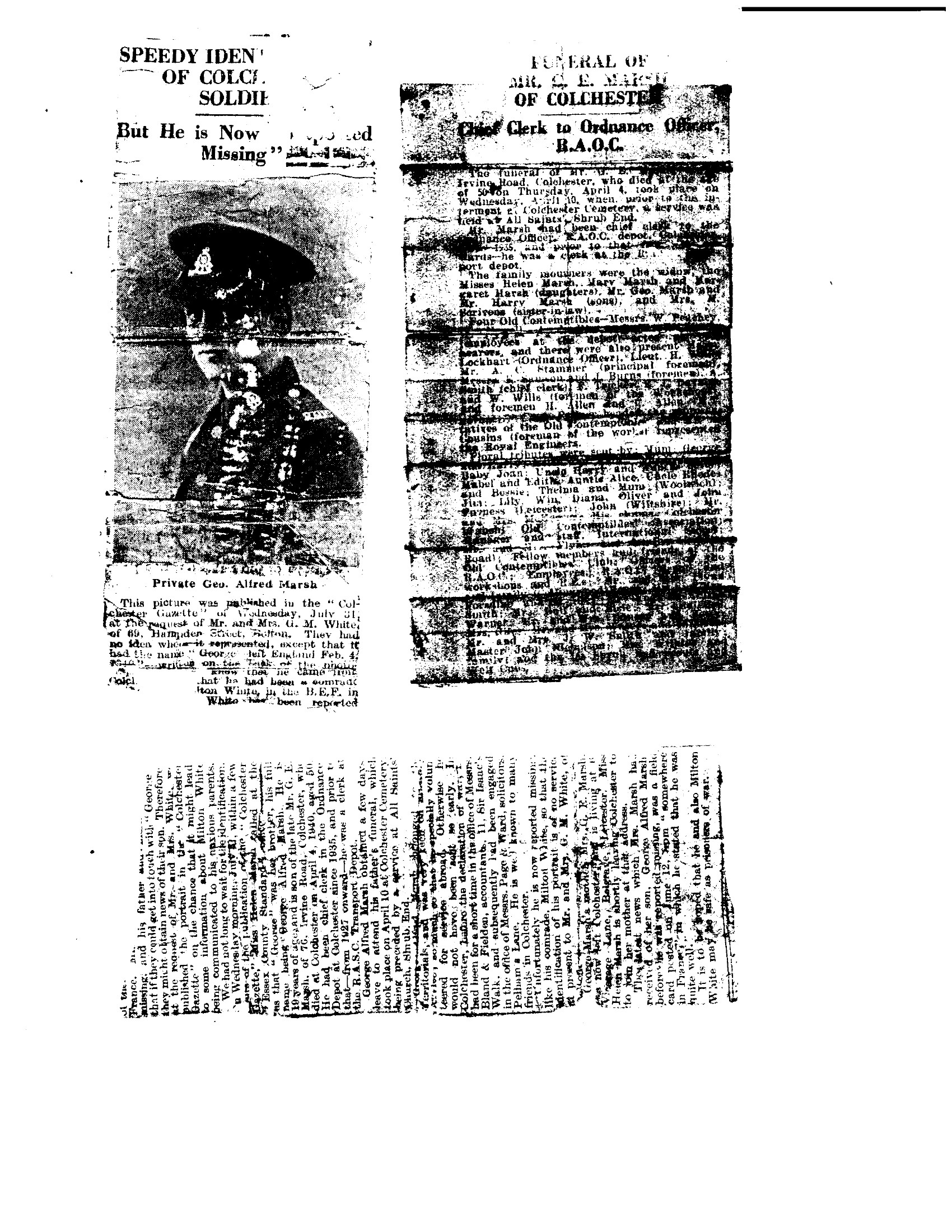
1. At age 10, George contracted diphtheria and then scarlet fever in quick succession; scarlet fever can cause kidney damage, which may explain his incontinence.
2. “George Alfred Marsh belonged to the Territorials, and was very keen on [unreadable], so much so that he specially volunteered for service abroad. Otherwise, he would not have been sent so early.” — The Colchester Gazette, 1 August 1940.
3. The full inscription on the back of the photograph read: “George—left England Feb. 4, 1940. Father recently [died.] L.-cpl., R.A.O.C.”
4. The final line of The Colchester Gazette, 1 August 1940 article reads: “It is to be hoped that he and also Milton White may be safe as prisoners of war.”