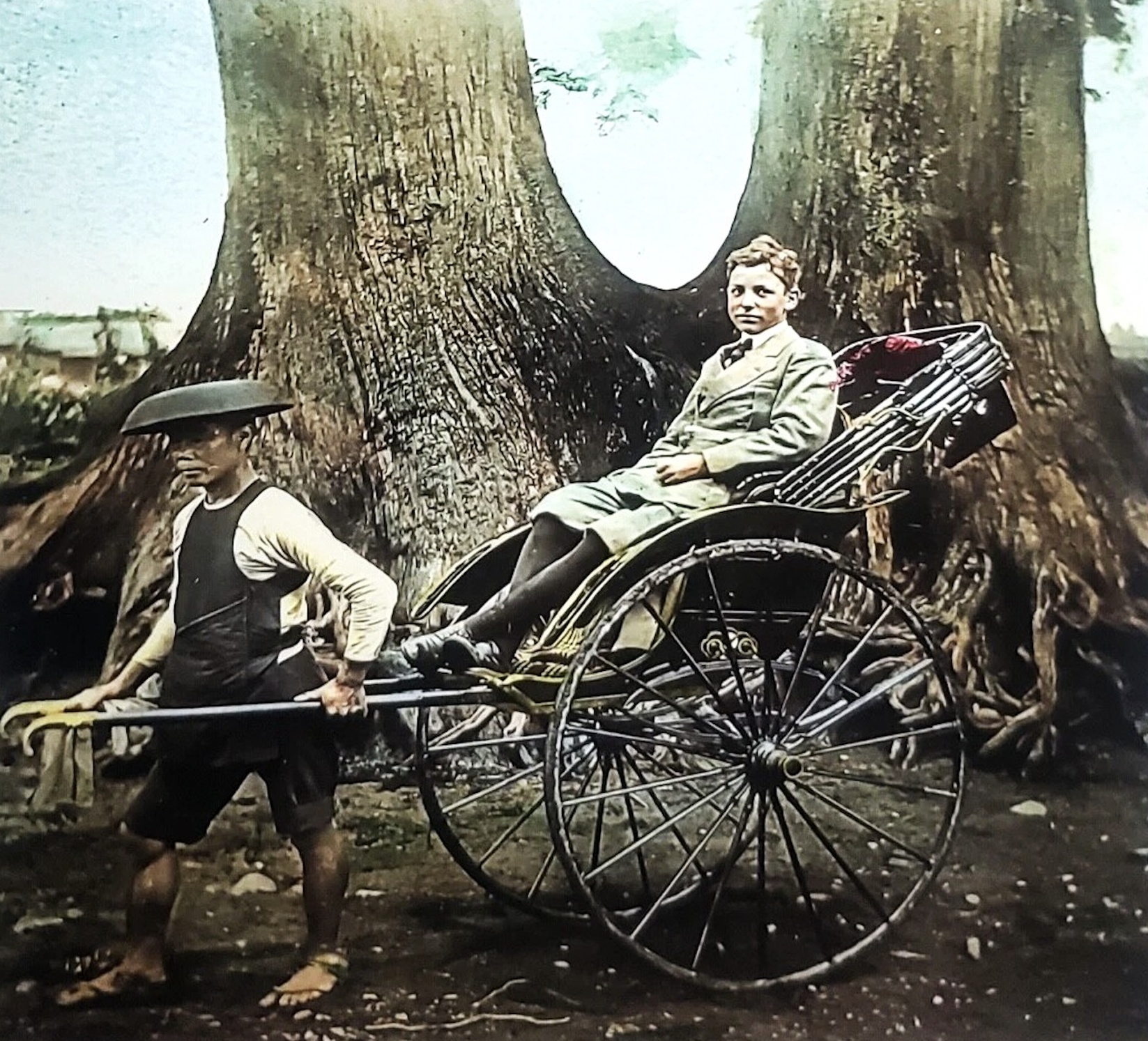
Clarence in a Rickshaw
Poetry
From his journal, we know the date: April 10th, 1908—just disembarked
onto Japanese soil, long-awaited climax to the family’s Oriental tour. He was fourteen.
They are posed against an ancient tree, two imposing trunks dark and fissured
like fan pleats, joined in a vee obscuring the Yokohama harbor piers beyond.
Their bodies mimic the trunk angles: Clarence reclines tentatively on the seat, one hand on his lap, while below
the rickshaw puller leans forward, sandaled feet planted in the earth, calves bulging to take up momentum.
The rickshaw is elegant, like a two-wheel pony trap: chest-high wheels, leaf suspension,
intricate bellows top accordioned down behind the seat, so that the rider may enjoy the view.
Clarence gazes at something over the right shoulder of his photographer brother Sidney, a whiz
with the Brownie camera. He is avoiding eye contact, even suppressing a giggle,
not sure of how one is supposed to behave upon a human-powered perch.
The puller will bear him to their hotel. His eyes are fixed left on the destination off-camera, thumbs
on the rickshaw rails pointing the way. Clarence noted: “It certainly seems very queer and unnatural
to ride in a narrow little carriage all by yourself, with a man running in front to pull you.”
The photo has been retouched and tinted: Blue spattered sky, some smears of green foliage,
a scarlet paisley blanket in the rickshaw bonnet. Clarence’s cheeks and wrist are rendered pink,
while the puller’s stolid face is washed in ocher, blending into massive roots behind him.1
1. My grandfather, Clarence Gamble, was an heir to the Procter & Gamble family, physician, and a pioneer in world family planning. He was also a proponent of eugenics, the discredited pseudoscientific theory that humanity could be improved by manipulating the gene pool, and he encouraged well-to-do, well-educated white families to have many children, while promoting programs of targeted birth control and sterilization in the developing world and in impoverished parts of the U.S., particularly the rural South. The photo described in the poem comes from the cover of Japan 1908: The Adventure of Fourteen-Year-Old Clarence James Gamble, which consists of journal entries he kept while on a ten-week missionary tour of Japan with his parents and brother, and provides some insights into how his worldviews evolved.